Margarita Kotikovskaya: A Jewish Sniper Who Uncovered the Fate of 800 POW’s
On a rainy spring day in 1942, Margarita Kotikovskaya, a Jewish woman from the Odessa Oblast (administrative region) emerged from a dugout at a Red Army regimental command post, clutching her forage cap in her hands. A fourth-year law student at Leningrad University when Germany invaded the Soviet Union, Margarita had been called up to serve as a lieutenant with the 4th Guards Rifle Division of the Leningrad Army of the People’s Militia.
As Margarita rose from the dugout, she came face-to-face with nineteen-year-old Yevgeni Nikolaev, commander of an artillery regiment.
Yevgeni assumed she was “a new typist or an orderly from the medical section.” He could not see the tabs on her collar, hidden beneath her waterproof cape, indicating rank in the Red Army.
“Why no greeting?’” she asked suddenly.
Caught off-guard by her candidness, Yevgeni, who writes about this encounter in Red Army Sniper: A Memoir of the Eastern Front in WWII, scrambled to his feet, stood tall and gave her a salute.
“Let’s get to know each other,” she said. “I’m Margarita Borisovna Kotikovskaya, military investigator for the divisional prosecution office.”
Yevgeni couldn’t figure out why this thin-lipped young woman, with close-set dark eyes and a head of wavy chestnut hair chopped bluntly at earlobe-length, had addressed him.
He had no idea that 23-year-old Margarita had recently learned that her husband, serving in the navy, was missing in action. He had no idea that Margarita, who’d dreamt of becoming a detective since childhood, would not let anything or anyone get in her way.
Margarita’s next words, for Yevgeni, were completely “unexpected.”
“Teach me to shoot with a sniper’s rifle!”
Speechless, Yevgeni watched as Margarita pulled a Tokarev from hern holster and “pointed to a telegraph pole. On it some curling, tornoff wires were swaying in the wind, while some lonely green ‘cups’ showed up on the metal cross-pieces. Three shots rang out, one after the other, and, after each one, green fragments splashed onto the ground.”
“Impressive,” Yevgeni said, “convinced that Margarita Borisovna was a crack shot.” Still, this was “not enough to be a Nazi killer…the real skill lies in finding the target, tracking it down.”
Yevgeni agreed to teach Margarita to become a sniper. This was not the first request he’d had from a female in the Red Army. Earlier that year, Medical Orderly, Marusya Mitrofanova had asked him to “teach her sniping.”
After practising on homemade targets, Marusya “went out ‘hunting’,” and took out “two Nazis at once.”
A couple of weeks after their initial meeting, Yevgeni brought Margarita and a spare sniper’s rifle to the front line at a Leningrad suburb, occupied by Wehrmacht forces (defense forces of Nazi Germany). The Red Army was embroiled in a fierce battle to to break the siege of Leningrad, a military blockade held by Germany and Finland since September, 1941.
“At first Margarita Borisovna only came along as a partner, observed my operations and got herself acclimatised to the environment,” Yeggeni writes. Over “her period of probation,” he taught her how to shoot in various situations. When he decided she was ready for the real thing, “This appealing and courageous girl wiped out thirty Nazis in my presence alone.”
For the next three years, Margarita defended Leningrad as a sniper. She was one of many valiant female snipers during the Siege of Leningrad. Yet, all of these women were erased from the historical narrative by the Communist Party. Joseph Stalin, premier of the Soviet Union, was determined to re-populate the country after 25 million lives, military and civilian, were lost during WWII. To this end, women were forbidden to discuss their combat achievements. Instead, they were encouraged to return to their most important role, motherhood. In fact, Stalin announced the creation of a new medal, for women who bore at least ten children.
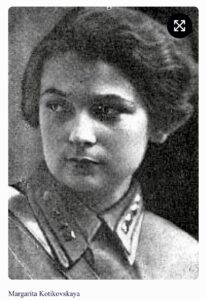
Margarita was a sniper for three years during the Siege of Leningrad.
In 1950, Margarita reached her childhood goal. She became a major crimes detective at the Ministry of Internal Affairs. Her husband’s whereabouts remained a mystery. While working as a detective, she continued looking for information about him. Eventually, she became “engaged in searching for dead and missing Soviet soldiers, and this became her life’s work.” https://www.yadvashem.org/research/research-projects/soldiers/margarita-kotikovskaya.html
She retired from the Ministry of Internal Affairs as a police colonel. Determined to locate the names and fates of missing Soviet POWs, she moved to Germany in 1997. She discovered Herbertshausen, explained by Yad Vashem as “a wartime shooting range that was located 5 km from the Dachau Concentration Camp. There, Wehrmacht soldiers trained by shooting at live targets, and Soviet POWS (about 7,000 persons in total) were brought there for this purpose.”
Margarita found and compiled the names of “863 murdered Soviet soldiers and officers who had been listed as “missing in action”.” This record, called “Margarita’s List,” gave relatives devastating yet crucial information about the fate of their loved ones.
But Margarita wasn’t finished. Indomitable, she continued to search for her husband. With the help of German archivists, she discovered that in August, 1941, her husband had been on a ship that had been captured by the enemy. All of the Soviet men were “transferred to a prison in the German-occupied town of Kingisepp, and shot almost immediately upon arrival.”
Margarita never remarried or had children. She died in Munich in 2011. She was 91 years-old.