Polina Gelman: An Inspiring Jewish Navigator in The Night Witches Who Never Gave Up!
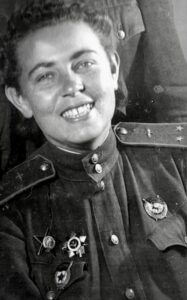
A Jewish Navigator in The Night Witches
Despite being told she was too short to fly in 1938, Polina (Lina) Gelman became one of the most skilled navigators in the Night Witches regiment. With the help of cushions behind her back, and wood blocks on the rudder pedals, Polina (who was not even five feet tall) completed 860 missions, dropped 113 tons of bombs, caused 142 fires, and dropped 620,000 leaflets with anti-Nazi propaganda on German troops.
In fact, Polina was the only Jewish woman who served in the war to earn a Hero of the Soviet Union medal, the U.S.S.R.’s highest commendation for military service, Arkadi Zeltser, a historian at Yad Vashem, told The New York Times in 2025.
On the day she was born, in 1919, “a shell from the air destroyed half of the hospital, and my mother was in the half of the building that was safe,” Polina told Anne Noggle, author, A Dance with Death. “I consider it to have been a good sign because I am still alive!”
Five months later, her father was killed in the country’s Civil War.
Polina’s love of flying began with gliding lessons while she was in secondary school. On her first flight, she “had difficulty reaching the controls.” As she slid down to get her feet to the pedals, the instructor couldn’t see her. “When we landed he called me such bad, dirty names that I have never heard again, and he said that I wouldn’t fly anymore because I was too little.”
Polina’s route to becoming a flight navigator is a story of unending perseverance. She had almost completed her third year of university when Germany invaded the Soviet Union. Even after she tried, unsuccessfully, to enlist, she didn’t give up, maneuvering her way through steep barriers to get to where she wanted to be.
Once she’d been accepted into Marina Raskova’s regiment, she explained why she’d joined in a letter to her mother: “I am a daughter of the Jewish people and I have a particular account to settle with Hitler.”
Her studies in history led to Polina being chosen as politruk, political commissar, an unpopular role that involved turning comrades in for speaking against the Soviet regime. From the start, Polina decided she would not tell on her winged sisters. Instead, she focused on other, more appealing tasks that required her knowledge and passion for history. She wrote and published a regiment magazine, and organized debates, discussions and lectures designed to boost morale.
From the moment the Night Witches regiment was formed, the devotion to the ‘Motherland’ was clear. “Everyone was a patriot,” Polina told Reina Pennington, author, Wings, Women, & War. “Often they hadn’t even completed a landing before they were already spoiling to carry out the next flight. The men even attempted to stop us, they said, the less you fly, the longer you’ll live…
“We relied on one another as if we were family. Our commander, Lt. Col. Evdokiia Davydovna Bershanskaya, played a tremendous role in this.”
Interestingly, Polina flew dozens of sorties with Senior Lieutenant Maguba Syetlanova, a Tatar pilot who’d overcome significant obstacles to achieve her dream of flying. The Jewish navigator and Muslim pilot had both seen their heritages largely erased by Stalin’s atheist regime. In 1944, Stalin ordered deportation of the entire Crimean Tatar community, 200,000 people, falsely accusing them of collaborating with the Nazis. They were crammed onto freight cars bound for central Asia. Almost half died on the way. Studying the Tatar native language was banned, books were burned and mosques destroyed.
The treatment of Jews was more convoluted. Before the war, Jewish culture had been suppressed, except for Yiddish activities, like theater and newspapers. Right after the Nazi invasion of Poland and the Soviet Union, hundreds of thousands of Polish Jews were deported to work camps in Siberia. Had they remained in Poland, these Jews would have been killed. In Siberia, most survived despite brutal conditions.
Still, Stalin’s regime did not recognize Jews as being targeted by the Nazis, even when confronted by mass graves of Jews at Babi Yar in Kiev and Rumbula in Riga.
Years after the war, Polina expressed her pride when it came to the Night Witches’ record, telling Pennington, “Our regiment firmly held first place among all in the Air Forces for the number of flights” adding, “female thoroughness and sense of responsibility obviously played a role in this.”
Polina went back to Moscow University and completed her history degree. At the same time, she graduated from the Academy of Military Interpreters. She worked as a military officer, married a Russian, and had one daughter, named Galina, after her beloved friend, Galya Dokutovich, killed in combat.
She visited Israel as a “government guest” in the early 1990s and, from the Jewish Virtual Library, we know that a street in Ashkelon has been “named in her honor.”
References:
Pennington, Reina, Wings, Women, & War: Soviet Airwomen in World War II Combat. University Press of Kansas, 2001.
Noggle, Anne, A Dance With Death: Soviet Airwomen in World War II. Texas A&M University Press, 1994.
https://jewishvirtuallibrary.org/polina-gelman