Jewish Sisters in The Night Witches: Only 1 Survives
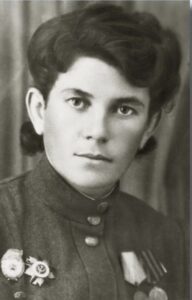
Meri worked tirelessly as a mechanic for the ‘Night Witches’ regiment.
Meri and Ida Zhukovitskaya were from a large Jewish family in Ekaterinoslav, on the west bank of the Dnieper River (Today, it’s Dnipro, Ukraine). Meri, two years older than Ida, was born in 1918. By the time Ida came along, in 1920, the city’s Jewish population was nearing 40 percent. Ekaterinoslav was located within the Pale of Settlement, a million square kilometers of land far from major cities, designated for Jews by Catherine the Great in 1791. Jews were banned from living and working in Russia’s interior which meant the density of Jews in the Pale greatly increased over time.
The sisters were born amidst a tumultuous period, with the Russian Revolution and brutal pogroms (attacks) as well as rampant sexual assaults against Jewish women. In 1919, the Soviet government nationalized stores, factories and workshops. People lost their money, jobs and the right to live openly as Jews. Making matters worse for Meri and Ida, their father was ill with tuberculosis.
Meri completed seven school grades followed by a few vocational courses, as seen in Yad Vashem’s International Institute for Holocaust Research, ‘Jews in the Red Army, 1941-1945’. While working at the Dnepropetrovsk Train Car Plant, “she attended a lecture on aviation by the head of an aero club at the plant, and this event was to change the course of Meri’s life.
“In 1938, she joined the aero club. Initially, she served as technical secretary of the flying section, and then proceeded to work at the club as an airplane technician.”
Meanwhile, Ida finished school and took a job as a railroad telegraph operator in Moldavia, 650 kilometers from Ekaterinoslav.
Right after the Germans invaded the Soviet Union in June 1941, Meri volunteered “for frontline duty.” Instead, because of her experience as an aircraft technician, she was sent to Saratov, more than a thousand killometers from her family in Ekaterinoslav, to work in an aircraft plant.
A Yad Vashem article about Ida says she fled Moldavia “before the occupation of that territory by German and Romanian troops,” eventually joining her sister in Saratov.
Marina Raskova, a renowned navigator known affectionately as the “Russian Amelia Earhart” came to Saratov in January 1942, in search of young women for three unprecedented female aviation regiments she was organizing. She recruited Meri as an aviation technician but wasn’t interested in Ida, who had no experience within the field.
The bond between Meri and Ida was demonstrated by the pressure they put on Raskova, eventually convincing her “to accept them both.”
Ida trained vigorously, twelve hours a day, to become a gunner and radio operator.
Raskova assigned them to the night-bomber regiment (Night Witches), where the girls flew archaic Po-2s, open-cockpit bi-planes made of canvas and wood. Meri, as a mechanic, facilitated “approximately one hundred night sorties (missions), while the regimental group under her command was responsible for more than 720 sorties.”
Ida’s time as a night witch came to an abrupt and tragic end in September 1942 “during a training flight, when her plane caught fire.” She was 22 years old.
This would have been a devastating loss for Meri. A few months later, she was joyfully reunited with her brother Boris, a tank officer, when their paths crossed in the rural steppes.
Marina Chechneva recalls their brief reunion in her 1975 memoir, My Fighting Girlfriends: “Brother and sister threw themselves into each other’s arms. Mary crried and smiled through her tears.
“And I thought you could only read about such encounters in books, Polina Belkina remarked in surprise.”
Meri, “one of the best mechanics in the regiment,” prepared her crews’ aircraft for combat flights over the Caucasus, the Kuban, Crimea, Poland and Germany. Once, after Polina Belkina’s plane crashed on takeoff. It was terribly damaged yet Meri and senior technician, Tatyana Alekseeva, rebuilt the aircraft, piece by piece. Two days later, it was back in service.
During an airfield attack Meri’s leg was badly injured. “She was given half a year’s leave to recover, but returned to her regiment after a mere three months. “Give me anything,” she said. “I have to be here.” Because of her compromised health, she could no longer work as a mechanic, so she was made assistant to the chief of staff of the squadron.”
After the war, Meri was awarded the Order of the Patriotic War and, for her selfless service in combat, the Order of the Red Star. She shared her good news in a letter to the regimental commissar, Evdokia Yakovlena:
Thank you from the bottom of my heart, dear Evdokia Yakovlena, that in a difficult moment, when my mother died and when Ida perished, you replaced my mother, and the regiment became my own family.”
She married Senior Sergeant Vasily Latyshev, from an airfield maintenance battalion. They had two daughters, Irina and Svetlana.
Meri was 67 when she passed away in 1985.
Read The Night Witches by Shelly Sanders:
https://bookshop.org/p/books/the-night-witches-a-novel-shelly-sanders/113d64fc9e6f51a2?ean=9780063445345&bkshp-astro=t
https://www.booksellers.ca/books/the-night-witches-a-novel-9781443476508?srsltid=AfmBOoqH3vWnDL4IjR7JDdPEdr0Pxp0aTwf2IvXtg-9o2qThEnPk1htB
https://www.target.com/p/the-night-witches-by-shelly-sanders-paperback/-/A-1013129203?TCID=OGS&AFID=google&CPNG=Entertainment&adgroup=247-60
https://www.harpercollins.com/products/the-night-witches-shelly-sanders?variant=45306334838818
Sources:
‘Jews in the Red Army’, International Institute for Holocaust Research. Yad Vashem.
https://www.yadvashem.org/research/research-projects/soldiers/meri-zhukovitskaya.html
https://www.yadvashem.org/research/research-projects/soldiers/ida-zhukovitskaya.html
My Fighting Girlfriends, by Marina Chechneva. 1975. Accessed through https://www.jewmil.com/biografii/item/740-zhukovitskaya-meri-iosifovna